Never Again a Man Charles Mathias
| Charles Mathias | |||
|---|---|---|---|
 | |||
| Chairman of the Senate Committee on Rules and Administration | |||
| In office Jan 3, 1981 – January three, 1987 | |||
| Preceded past | Claiborne Pell | ||
| Succeeded by | Wendell H. Ford | ||
| United States Senator from Maryland | |||
| In role January 3, 1969 – January 3, 1987 | |||
| Preceded by | Daniel Brewster | ||
| Succeeded past | Barbara Mikulski | ||
| Member of the United States Business firm of Representatives | In function January three, 1961 – January 3, 1969 | ||
| Preceded by | John R. Foley | ||
| Succeeded by | John Glenn Beall Jr. | ||
| Member of the Maryland House of Delegates | |||
| In part 1959–1960 | |||
| Personal details | |||
| Built-in | Charles McCurdy Mathias Jr. (1922-07-24)July 24, 1922 Frederick, Maryland, U.S. | ||
| Died | January 25, 2010(2010-01-25) (aged 87) Chevy Chase, Maryland, U.S. | ||
| Political political party | Republican | ||
| Spouse(s) | Ann Bradford | ||
| Alma mater | Haverford College Yale University University of Maryland Schoolhouse of Law | ||
| Profession | Chaser | ||
| Faith | Episcopalian | ||
| Military machine service | |||
| Service/branch | United States Navy | ||
| Battles/wars | World State of war II | ||
Charles McCurdy "Mac" Mathias Jr. (July 24, 1922 – January 25, 2010) was a Republican member of the United States Senate, representing Maryland from 1969 to 1987. He was likewise a member of the Maryland Business firm of Delegates from 1959 to 1960, and of the United states House of Representatives, representing the Maryland's 6th congressional district|6th congressional district of Maryland from 1961 to 1969.
After studying law and serving in the Us Navy during Globe War II, Mathias worked as a lawyer and was elected to the state legislature in 1958. In 1960, he was elected to the U.S. House of Representatives from Western Maryland. He was re-elected three times (1962, 1964, 1966), serving in the Firm for 8 years, where he aligned himself with the and then-influential liberal wing of the Republican Party.
Mathias was elected to the Senate in 1968, unseating the incumbent Democrat, Daniel Brewster, who twenty years before had been his roommate while attending the University of Maryland School of Law. He continued his record as a liberal Republican in the Senate, and ofttimes clashed with the conservative wing of his political party. For a few months in late 1975 and early 1976, Mathias considered running an insurgent presidential campaign in an endeavor to stave off the increasing influence of bourgeois Republicans led past Ronald Reagan.
His confrontations with conservatives cost him several leadership positions in the Senate, including chairmanship of the Judiciary Committee. Despite isolation from his conservative colleagues, Mathias played an influential function in fostering African American civil rights, ending the Vietnam War, preserving the Chesapeake Bay, and constructing the Vietnam Veterans Memorial. He retired from the Senate in 1987, having served in Congress for twenty-vi years (eight years in the U.Southward. House of Representatives and eighteen years in the U.S. Senate).
Contents
- i Early life and career
- 2 In the House of Representatives
- 3 United States Senate career
- 3.one Ballot of 1968: unseating Brewster
- 3.2 Showtime term (1969–1975): disharmonize with Nixon
- 3.iii Election of 1974: challenge from Mikulski
- 3.4 Second term (1975–1981): unease with the growth of conservatism
- 3.5 Election of 1980: uncertain party renomination
- 3.6 Final term (1981–1987)
- iv Legacy and postal service-Senate life
- 5 References
- six External links
Early on life and career
Mathias was born in Frederick, Maryland, the son of Theresa (née Trail) and Charles Mathias, Sr. His male parent was politically active, and he was a descendant of several Maryland legislators.[1] Afterward graduating from Frederick High School,[2] Mathias graduated from Haverford College in Pennsylvania in 1944. He went on to attend Yale Academy and received a law degree from the Academy of Maryland School of Law in 1949.[3] Effectually this time, Mathias met his future wife, Ann Bradford, at a birthday party for his law schoolhouse roommate Daniel Brewster. Ann Bradford is the daughter of former Massachusetts governor Robert F. Bradford.[1]
In 1942, during World War Ii, Mathias enlisted in the Us Navy and served at the rank of seaman apprentice. He was promoted to ensign in 1944 and served sea duty in the Pacific Ocean, including the recently devastated Hiroshima, from 1944 until he was released from agile duty in 1946. Following the war, Mathias rose to the rank of captain in the U.s. Naval Reserve.[1] [3]
Mathias briefly served as assistant Attorney General of Maryland from 1953 to 1954.[3] From 1954 to 1959, he worked as the City Chaser of Frederick, where he supported civil rights for African Americans. He played a function in desegregating the local Opera House movie theater, which restricted African American seating to the back of the theater. Mathias also worked to relocate the Frederick post office and helped protect a park in the city.[1] In 1958, he was elected to the Maryland House of Delegates, serving from 1959 to 1960. As a consul, he voted in favor of Maryland ratifying the Fourteenth Subpoena to the The states Constitution, which secured African American rights following the American Ceremonious War. With his back up, the legislature ratified the subpoena in 1959, about 100 years after it was first introduced.[ane]
In the Business firm of Representatives
On January 4, 1960, Mathias declared his candidacy for the Firm seat of Maryland'south 6th congressional district.[4] He officially began his campaign in March, establishing public education and controls on government spending as two of his priorities should he be elected.[5] In the master elections of May 1960, Mathias handily defeated his two rivals, garnering a 3–1 margin of victory.[half-dozen]
Mathias' opponent in the general election was John R. Foley, a erstwhile judge who had unseated DeWitt Hyde in a Autonomous landslide in the state two years prior. Both candidates attacked each other's voting records, with Foley accusing Mathias of skipping more than 500 votes in the Business firm of Delegates and having the "worst Republican record in Annapolis".[7] Mathias previously accused Foley of voting "nowadays" (a de facto abstention) in the House too oftentimes, and argued Foley's inaction led to inflation and higher taxes.[viii] Mathias prevailed over Foley on election day in November 1960, unseating the 1-term incumbent and becoming the offset representative from Frederick County since Milton Urner in 1883.[9]
During his eight-twelvemonth career in the House, Mathias established himself as a member of the liberal wing of the Republican Political party, which was the most influential at the time.[10] He was the author of the "Mathias Amendment" to the unsuccessful 1966 civil rights bill on open up housing. Concerning environmental issues, Mathias sponsored legislation to make the Chesapeake and Ohio Canal a national park, and supported other conservation initiatives along the Potomac River.[11] He also served on the Judiciary Committee and the Commission on the District of Columbia.[12] As a fellow member of the D.C. Committee, Mathias was a proponent of establishing home rule in the District of Columbia.[13]
Us Senate career

Mathias defeated incumbent Democrat Daniel Brewster, despite the Democratic Party's iii–ane reward in registered voters.
Election of 1968: unseating Brewster
Leading upwards to the Us Senate elections of 1968, Mathias' proper name was frequently mentioned as a potential challenger to Democratic incumbent Daniel Brewster, his higher roommate. Representative Rogers Morton of Maryland's 1st congressional commune was also considering a run at Brewster's seat, but was dissuaded by Republican political party leaders in the state in favor of a Mathias candidacy. Their decision was largely due to the geography of Mathias' seat. Every bit representative of the 6th district, he already had established name recognition in both the Baltimore and Washington, D.C., metropolitan areas, the more densely populated and liberal areas of the state. Mathias' seat was also more likely to stay under Republican control, unlike Morton's seat, which was located on the socially conservative simply Democratic-voting Eastern Shore of Maryland. Mathias had also established a more than liberal voting tape, which was argued to serve him ameliorate in the land with a 3-1 Autonomous advantage in registered voters.[fourteen]
Mathias officially alleged his candidacy for the Senate on February 10, 1968, calling for troop reductions in the Vietnam War, and identifying urban bane, racial discrimination, welfare reform, and improving public schools as major problems.[11] As the entrada drew on, the two primary problems became the war and law-breaking. Mathias argued that the extensive bombing campaigns in North Vietnam should exist reduced, while Brewster had argued for increasing battery. Brewster adopted a hard line stance on constabulary and gild, while Mathias advocated addressing the precipitating causes of poverty and the low standard of living in urban ghettos. Campaign finances were also an issue, with controversy erupting over Brewster's receipt of $xv,000 in entrada contributions from his Senate staff and their families.[12] On November v, 1968, Mathias was elected, garnering 48% of the vote to Brewster's 39% and perennial candidate George P. Mahoney's 13%.[15]
First term (1969–1975): disharmonize with Nixon
Mathias began his offset term in the Senate in January 1969 and laid out his legislative agenda before long thereafter. He was appointed to the District of Columbia committee, where he argued in favor of home rule in the district and providing D.C. residents full representation in both chambers of Congress. Both were positions he carried over from his career in the House.[13] In Dec 1970 he finally gained passage of legislation creating the Chesapeake and Ohio Canal National Historical Park.[16] He as well served as chair of the Special Committee on Termination of the National Emergency from 1971 to 1977, which produced Senate Study 93-549.[3] [17]
Over the course of his first term, Mathias was ofttimes at odds with his conservative colleagues in the Senate and the Richard Nixon administration. In June 1969, Mathias joined with beau liberal Republican Hugh Scott of Pennsylvania in threatening a "rebellion" unless the Nixon assistants worked harder to protect African American ceremonious rights.[xviii] He also warned against Republicans using the "Southern strategy" of attracting bourgeois George Wallace voters at the expense of moderate or liberal voters.[15] Mathias voted against two controversial Nixon Supreme Courtroom nominees, Clement Haynsworth and G. Harrold Carswell, neither of whom was confirmed. Mathias was also an early on advocate for setting a timetable for withdrawal of troops from Vietnam, and was against the bombing campaigns Nixon launched into Lao people's democratic republic.[15] In October 1972, Mathias became the starting time Republican on Ted Kennedy's Judiciary subcommittee and ane of only a few in the nation to support investigation of the Watergate Scandal, which was still in its early stages.[19]
Mathias' disagreements with the assistants became well-known, causing columnists Rowland Evans and Robert Novak to name him the "new supervillain... in President Nixon's doghouse".[twenty] Evans and Novak also commented that "not since [Charles Goodell] was defeated with White House connivance has any Republican so outraged Mr. Nixon and his senior staff as Mathias. The senator's liberalism and tendency to commodities political party lines have bred antagonism in the inner sanctum".[20] Due to their differing ideologies, there was speculation that Mathias was going to exist "purged" from the party past Nixon in a similar way as Goodell in 1971, merely these threats disappeared after the Watergate scandal escalated. By the numbers, Mathias sided with the Nixon administration 47% of the fourth dimension, and voted with the majority of his Republican colleagues in the Senate 31% of the time, during his first term.[xv]
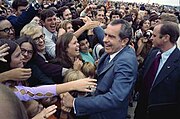
Mathias frequently clashed ideologically with the Richard Nixon Administration.
In early 1974, the group Americans for Democratic Action rated Mathias the nigh liberal fellow member of the GOP in the Senate based on 20 key votes in the 1973 legislative session. At xc percent, his score was higher than most Democrats in the Senate, and was quaternary highest amongst all members. Issues considered when rating senators included their positions on civil rights, mass transit, D.C. home dominion, tax reform, and reducing overseas troop levels.[21] The League of Women Voters gave Mathias a 100% on problems important to them, and the AFL-CIO agreed with Mathias on 32 out of 45 key labor votes. Conversely, the conservative grouping Americans for Constitutional Action stated Mathias agreed with their positions only 16% of the time.[15]
Election of 1974: challenge from Mikulski
As a Republican representing heavily-Democratic Maryland, Mathias faced a potentially hard re-election bid for the 1974 election. State Democrats nominated Barbara Mikulski, so a Baltimore City Councilwoman who was well-known to residents in her city every bit a social activist, just with limited proper noun recognition in the rest of the state.[22] Mathias was renominated by Republicans, fending off a main election challenge from conservative doctor Ross Pierpont. Pierpont was never a substantial threat to Mathias, whose lack of competition was due in part to fallout from the Watergate scandal.[15] [23]

Barbara Mikulski challenged Mathias for his seat in 1974.
As an advocate for campaign finance reform, Mathias refused to accept any contribution over $100 to "avert the curse of large money that has led to so much trouble in the terminal year".[24] Still, he still managed to enhance over $250,000, nearly five times Mikulski's total. Ideologically, Mikulski and Mathias agreed on many bug, such every bit endmost tax loopholes and easing taxes on the centre class. On ii bug, notwithstanding, Mathias argued to reform Congress and the U.Southward. taxation system to accost aggrandizement and corporate price fixing, opposite to Mikulski.[22] In retrospect, The Washington Post felt the election was "an intelligent discussion of state, national, and strange affairs past 2 smart, well-informed people".[25]
With Maryland voters, Mathias benefited from his frequent disagreements with the Nixon administration and his liberal voting record. On November 5, 1974, he was re-elected by a 57% to 43% margin, though he lost badly in Baltimore City and Baltimore Canton, where Mikulski was popular.[22]
Second term (1975–1981): unease with the growth of conservatism
In 1975, Mathias co-introduced legislation with Illinois Senator Adlai Stevenson III that would prohibit foreign aid to South Vietnam after June 30, 1975.[26]

Mathias expressed concern over the growing influence of conservatives in the Republican Party during the 1976 campaign betwixt Gerald Ford and Ronald Reagan.
Mathias expressed concerns with the state of his political party leading upward to the 1976 presidential ballot, specifically its shift further to the right. Referring to the nomination competition betwixt Gerald Ford and Ronald Reagan, Mathias remarked that the party leadership was placed "in farther isolation, in an farthermost—almost fringe—position". On November 8, 1975, he hinted at inbound some presidential main elections to steer the party away from what he saw as a strong conservative trend.[27] Over the next few months, Mathias continued to evidence signs of entering the election, but never campaigned aggressively and lacked whatsoever political organization.[28] Columnist George Will commented that Mathias was "contemplating a race—a stroll, really—for the presidency", in reference to his staid campaign.[29]
After iv months of consideration, Mathias decided in March 1976 to not seek the presidency, and asked for his name to be withdrawn from the Massachusetts chief ballot, where information technology had been added automatically. He had also been considering an contained bid, but said raising money would exist too difficult under entrada finance laws. Upon his withdrawal, Mathias stated he would work with the Republican Political party in the upcoming elections.[30] Notwithstanding, despite his pledge to support the Republican candidate, Mathias' criticism of the political party did non wane, stating that "over and over again during the primaries, I have felt uncomfortably like a member of the chorus in a Greek tragedy".[31] In a farther criticism of his party's fail of liberal voters, Mathias commented:
I've had to deal with some hard truths... People don't like to hear we've got only 18 per centum of the electorate. They pretend it's not important that our following amid blacks, and young people, and urban communities is not what it should be... But I feel it'south of the greatest importance that if there's to be a Republican Party, we look these facts in the face.[32]

Strom Thurmond blocked Mathias from serving as ranking member of the Judiciary Committee.
Mathias' candidacy consideration did not endear him to the bourgeois fly of the Maryland Republican Political party system. In June 1976, he lost a vote by state Republicans to determine who would represent Maryland on the platform committee at the 1976 Republican National Convention. Instead, the group chose George Cost, a bourgeois member of the Maryland Firm of Delegates from Baltimore Canton. At 1 signal, Mathias was close to beingness denied omnipresence to the convention altogether equally an at-large consul, but a terminal infinitesimal compromise ensured all Republican congressional representatives seats equally at-big delegates.[31] Mathias maintained a low profile during the convention, and received harsh criticism from some of the bourgeois delegates from Maryland who attended.[32]
At the first of the new Congress in 1977, Mathias was in line for several potential committee promotions to ranking member. However, Mathias' outspoken criticism of the party in the previous election bike aroused enmity amongst his colleagues. On the Judiciary Committee, Mathias had the most seniority of whatever other member except Strom Thurmond of South Carolina, who already held another ranking membership on the Armed Services Committee. Only one ranking membership was immune per senator, so Thurmond resigned his ranking membership on the Armed Services Committee to circumvent Mathias serving equally ranking member of the Judiciary Committee. Mathias was also prevented from assuming leadership positions on the Authorities Operations Committee following a power struggle, and on the Judiciary Subcommittee on Constitutional Rights. On the latter subcommittee, Mathias had more than seniority than any other fellow member. However, party leaders were uneasy with the idea of allowing Mathias to team upwardly with liberal Democrat and subcommittee chairman Birch Bayh, and voted instead for William 50. Scott as ranking member.[33]
Election of 1980: uncertain party renomination

Senator Mathias exhibits his grip strength with a hand dynamometer during a tour of the Gerontology Research Center testing laboratories of the National Institutes of Health, 1980.
After these slights, speculation was raised that Mathias would leave the Republican Party, particularly equally the 1980 elections were approaching. Several prominent conservatives in the state, such every bit U.Due south. Representatives Marjorie Holt and Robert Bauman, were because challenging Mathias for his seat. In dissimilarity, the Democratic side of the aisle had fewer challengers, suggesting Mathias would win renomination more hands if he were to switch parties.[33] However, Mathias chose to remain as a Republican, and teamed up with eight other Republican senators to express their dissatisfaction with the hard-line wing of the political party.[34] Mathias later stated that he had never seriously considered switching parties.[ten]
When it came fourth dimension to nominate members to the 1980 Republican National Convention, Maryland Republicans voted for Mathias and Bauman equally co-chairmen of the delegation to represent the liberal and bourgeois wings of the party, respectively. The 1980 nomination contest lacked the "fierce ideological grouse that marked the 1976 state convention", in which Mathias was nearly excluded equally a consul.[35]
Despite initial concerns that a potent bourgeois would run in the 1980 Republican primary, Mathias did non face any major opposition for his seat. He easily won his political party'south nomination, and was re-elected by a substantial margin in November.[36] His Autonomous analogue in the ballot, Edward T. Conroy, positioned himself as more conservative than Mathias. Conroy likewise made national defense the primary issue of his entrada, where he defendant Mathias of existence weak. Mathias countered, stating he had voted for over $1.one trillion in defense spending during his career in the Senate.[25] By winning easy re-ballot, Mathias became the starting time Maryland Republican to win election to a tertiary Senate term, and as well the but Republican to win the metropolis of Baltimore up to that indicate.[10] He likewise secured support from several precincts of Baltimore's Autonomous political machine, and several labor unions.[36]
Last term (1981–1987)
Afterward Republicans gained control of the Senate in 1981, Mathias sought the chairmanship of the Judiciary Committee but was relegated to the relatively mundane chairmanship of the Rules Commission.[ten] He was besides appointed chairman of the Government Operations Subcommittee on Government Efficiency and the District of Columbia, and accustomed a seat on the influential Foreign Relations Commission, though he had to sacrifice his seat on the Appropriations Committee to do and so.[37] In 1982, Mathias chaired a bipartisan Senate enquiry into the methods used by the FBI in the Abscam abuse investigation, which found that dozens of officials had been named for accepting bribes without basis.[38] He too served as co-chair of the Joint Commission on Printing from 1981 to 1983 and 1985 to 1987, and as a member of the Joint Committee on the Library from 1983 to 1987.[3]

Mathias speaking at the commissioning anniversary for the USS Baltimore attack submarine, July 24, 1982.
Leading up to the 1986 elections, it was unclear whether Mathias would seek a fourth term. His back up of President Reagan was lukewarm, which had further isolated him ideologically from his Republican colleagues. One delegate at the Maryland state political party convention had even called Mathias "liberal swine" for his record. Additionally, his frequent difficulties in securing a committee chairmanship along with his low attendance rate were raising questions regarding his ability. However, Mathias was showing signs of seeking re-election in 1985, and dismissed any claims of ineffectiveness. Mathias claimed "inside a matter of minutes, I can talk to any fellow member of the Cabinet; and I could become see them within 24 hours.... Information technology was no accident that the Chesapeake Bay was mentioned in the President's State of the Wedlock address. That took a lot of hard piece of work".[39]

The retirement announcements by Mathias and Paul Laxalt concerned Republican party leaders.
Despite initial indications otherwise, Mathias announced on September 27, 1985, that he would non seek a fourth term. His annunciation concerned Republican party officials in the state, who feared that local Republicans had poorer election chances without Mathias at the top of the ticket. At the national level, Mathias' proclamation came shortly after news that Republican Paul Laxalt of Nevada would be retiring equally well. The departure of two Republican senators from swing or Autonomous-leaning states was treated past Republican party leaders as a poor sign of the party's chances in the upcoming elections.[40] Linda Chavez won the Republican primary for the Senate seat, and she lost the full general ballot to Democrat Barbara Mikulski.
Mathias remained agile in his terminal days in the Senate, playing an important role in removing a capital punishment provision in a 1986 Senate drug nib later threatening filibuster, and in preparing impeachment proceedings against federal guess Harry E. Claiborne.[41] Mathias' last twenty-four hours in the Senate was January 3, 1987,[iii] at which signal he was succeeded by Mikulski.[42]
Legacy and post-Senate life
Mathias held a retirement party at the Baltimore Convention Center on July fourteen, 1986, which had over 1,200 attendees. The gain from the outcome, at $150 per person, were used to plant a strange studies program at the Johns Hopkins University Schoolhouse of Advanced International Studies in his name. Mathias planned to teach at Johns Hopkins following his departure from the Senate.[43]
Donald P. Baker of The Washington Post commented that Mathias' lasting reputation would be that of a bohemian. Though he was elected to the Firm in 1960 as a moderate/conservative, his life in the Congress moved him to the middle, and he frequently deviated from the party line and sided with Democrats. The fact that he "went out of his manner to disassociate himself from [Ronald Reagan]" in the 1980 elections had hindered his chances at a chairmanship. Mathias also established a record on civil rights, having played an important role in passing a fair housing bill while he was in the House, and too in establishing a national holiday for Martin Luther King Jr. He held liberal views on abortion, defense spending, and the Equal Rights Subpoena,[10] and, along with Senator John Warner of Virginia, was one of the sponsors of a bill to authorize the structure of the Vietnam Veterans Memorial.[44] In discussing Mathias' retirement, Tom Wicker of The New York Times commented that "he was fair, flexible, concerned, able to ascent above partisanship only not above responsibility". When Wicker asked him which senators he respected the most, Mathias listed J. William Fulbright (D), Jacob Javits (R), John Sherman Cooper (R), Cliff Instance (R), Phil Hart (D), Mike Mansfield (D), and George Aiken (R), because "each i of those people would take an issue on his own responsibility... They'd simply come to the conclusion that this was the right affair for the country."[45]
On environmental bug, Mathias established a record as a stiff advocate of the Chesapeake Bay. After touring the bay shoreline in 1973, he sponsored legislation that led to a study by the United States Environmental Protection Agency (EPA) two years afterward, which was one of the beginning reports that made the public enlightened of harmful levels of nutrients and toxins in the waters. Every bit a event, the report was one of the catalysts for cleanup efforts, and evolved into the Chesapeake Bay Program.[46] [47] In recognition, the Charles Mathias Laboratory, part of the Smithsonian Institution, was established in 1988 every bit a research facility to analyze human being impact on the bay.[47] In 1990, the Mathias Medal was established past Maryland Body of water Grant at the University of Maryland Center for Environmental Scientific discipline as further acknowledgment of Mathias' ecology record.[48] In 2003, thirty years after he launched a written report of the Chesapeake, Mathias was recognized by the Army Corps of Engineers for the influential role he played initiating restoration efforts.[49]
From 1987 to 1993, Mathias was a partner at the law firm of Jones, Day, Reavis and Pogue.[50] In 1991, Mathias was called by the U.S. Federal Reserve Lath to atomic number 82 a committee to supervise the operations of First American Bankshares, Inc. Prior to his arrival, First American had been secretly acquired by Depository financial institution of Credit and Commerce International, which resulted in a major cyberbanking scandal.[51] Mathias was appointed chairman of the lath of Showtime American in Nov 1992, replacing quondam U.S. Chaser General Nicholas Katzenbach.[52] He continued every bit chairman of Offset American until 1999.[53]
Later on his retirement, Mathias served on numerous boards and committees. He was a member of the Governor's Committee on State Taxes and Tax Structure (1989–1990), a member of the Maryland Civil War Heritage Commission (1992–1995), a member of the Kaiser Commission on Medicaid and the Uninsured, co-chair of the Task Forcefulness on the Presidential Appointment and Senate Confirmation Process (1996), a member of the board of the George C. Marshall International Center, a fellow member of the board of the Centre for Responsive Politics, a member of the lath of WorldSpace Satellite Radio, and board fellow member emeritus of Brown University's Watson Establish for International Studies.[53] Additionally, Mathias served on the Board of Trustees of Enterprise Foundation (at present Enterprise Community Partners) from 1980 through 2001.
Equally of 2008, Mathias practiced law in Washington, D.C., and was a resident of Chevy Chase, Maryland.[three] On October 28, 2008, Mathias endorsed Sen. Barack Obama in the 2008 presidential ballot.[54]
Mathias died from complications of Parkinson's disease at his abode on January 25, 2010 at age 87.[55]
References
- ↑ i.0 one.i 1.2 1.3 one.4 Ebrahimian, Shirley (March 2005). "A Human for All Seasons". Frederick Magazine. p. A4.
- ↑ "Archived copy". Archived from the original on 2012-03-28. https://web.archive.org/web/20120328175057/http://world wide web.fredericknewspost.com/sections/news/brandish.htm?storyid=100566 . Retrieved 2010-11-09.
- ↑ 3.0 3.1 3.2 3.three 3.4 3.5 3.6 "Mathias, Charles McCurdy". United States Congress. http://bioguide.congress.gov/scripts/biodisplay.pl?alphabetize=M000241 . Retrieved 2008-07-06.
- ↑ "Mathias of Frederick Files For Foley's Seat". January 5, 1960. p. A9.
- ↑ "Republican Candidate Begins Race". March 13, 1960. p. B15.
- ↑ "Foley, Mathias Win in Maryland's 6th". May 18, 1960. p. A19.
- ↑ "Foley Assails Mathias On State Voting Record". September 22, 1960. p. B3.
- ↑ "Foley Vote Tape Hitting By Mathias". August 11, 1960. p. B5.
- ↑ Eisen, Jack (January iv, 1961). "Well-Wishers Inundate Mathias After he Takes Seat in Congress". p. A4.
- ↑ 10.0 10.1 10.2 10.iii 10.4 Baker, Donald P (September 29, 1985). "End of the Electoral Line for a Maryland Bohemian". p. C1. https://pqasb.pqarchiver.com/washingtonpost_historical/admission/139046412.html?dids=139046412:139046412&FMT=ABS&FMTS=ABS:FT&date=SEP+29%2C+1985&author=By+Donald+P.+Baker+Washington+Post+Staff+Writer&pub=The+Washington+Post&desc=Finish+of+the+Electoral+Line+for+a+Maryland+Maverick&pqatl=google.
- ↑ 11.0 11.1 Barnes, Bart (February 11, 1968). "Mathias Runs for Senate". p. A1.
- ↑ 12.0 12.1 Homan, Richard (November 6, 1968). "Upsets in two Nearby States Divide Business firm Seats Evenly". p. A1.
- ↑ 13.0 13.1 "Mathias to Introduce Home Rule Legislation". Jan twenty, 1969. p. C1.
- ↑ Eisen, Jack (January 2, 1968). "Mathias Points for Senate". p. B1.
- ↑ 15.0 xv.1 xv.2 15.3 15.4 fifteen.five Watson, Douglas (August 15, 1974). "Mathias Purge Threat Ends: White Firm Scandals Boost Senator's Re-election Bid". p. C1.
- ↑ Public Law 91-664
- ↑ Relyea, Harold C. (2001-09-xviii). "CRS Report for Congress: National Emergency Powers" (PDF). Congressional Research Service. https://fpc.land.gov/documents/organisation/6216.pdf . Retrieved 2008-08-07.
- ↑ Rich, Spencer (June 28, 1969). "Bourgeois Trend Decried". p. A1.
- ↑ Osnos, Peter (October 18, 1972). "GOP Senator Backs Sabotage Probe". p. A19.
- ↑ twenty.0 twenty.1 Rowland, Evans; Robert Novak (Dec five, 1971). "Mathias: The New Goodell". p. A2.
- ↑ Rich, Spencer (January 7, 1974). "Liberal Unit Rates Senators; Mathias Is Highest in GOP". p. A2.
- ↑ 22.0 22.1 22.2 Barker, Karlyn (November 6, 1974). "Mathias Is Elected To a Second Term". p. A12.
- ↑ Barker, Karlyn (September xi, 1974). "Mathias Wins GOP Doctor. Race". p. A24.
- ↑ Richards, Bill (February 3, 1974). "Sen. Mathias Re-Election Bulldoze Opens". p. B1.
- ↑ 25.0 25.1 "U.S. Senate Choice in Maryland". October 22, 1980. p. A22.
- ↑ Frum, David (2000). How We Got Here: The '70s. New York, New York: Basic Books. p. 306. ISBN 0-465-04195-7.
- ↑ Bakery, Donald P (November nine, 1975). "Mathias Says He May Run In Presidential Primaries". p. 21.
- ↑ Peterson, Nib (Feb 8, 1976). "The Quiet Presidential Entrada". p. 21.
- ↑ Will, George (Jan 25, 1976). "Sen. Mathias' 'Stroll'". p. 131.
- ↑ Peterson, Pecker (March 3, 1976). "Mathias Joins Almost-Rans, Will Not Seek Presidency". p. A3.
- ↑ 31.0 31.1 Peterson, Bill (June 26, 1976). "Dissident Mathias Denied GOP Platform Committee Postal service". p. A5.
- ↑ 32.0 32.1 Logan, Harold J (August xix, 1976). "Mathias' Convention Role Is Low-key". p. fourteen.
- ↑ 33.0 33.1 Evans, Rowland; Robert Novak (March 23, 1977). "The Republicans And Sen. Mathias". p. A11.
- ↑ Childs, Marquis (November 22, 1977). "Mathias's Bid to Save the GOP From Itself". p. A19.
- ↑ Barringer, Felicity (June ii, 1980). "Physician. Republicans' National Delegation Volition Exist Led past Mathias and Bauman". p. B1.
- ↑ 36.0 36.1 Baker, Donald P (Nov 5, 1980). "Mathias Crushes Underdog Challenger to Win Third Term in Senate". p. A21.
- ↑ Baker, Donald P (December 4, 1980). "Mathias Agrees to Head Senate Rules Committee". p. C5.
- ↑ Thornton, Mary (July 21, 1982). "Abscam Hearing Reveals 44 Were Unjustly Cited". p. A4.
- ↑ Muscatine, Alison (July 9, 1984). "Mathias Swims Against the GOP's Tide". p. B1.
- ↑ Sugawara, Sandra (September 28, 1985). "GOP'southward Mathias Says He Plans To Retire From Senate in '87". p. A1.
- ↑ Greenhouse, Linda (Oct 6, 1986). "Withal a Distinctive Voice, but Soon an Repeat". p. B8.
- ↑ McQueen, Michel (November v, 1986). "Schaefer, Mikulski Lead Democratic Sweep at the Superlative". p. A1.
- ↑ Kenworthy, Tom (July fifteen, 1986). "Sendoff for a Senator, 1,200 Honor Mathias on His Retirement". p. B1.
- ↑ Baker, Donald P (Nov 9, 1979). "Vietnam War Memorial". p. C1.
- ↑ Wicker, Tom (November sixteen, 1986). "A Skilful Man Going". p. E23.
- ↑ Pierre, Catherine (Feb 2004). "Stories from the Sediment". Johns Hopkins University Mag . http://www.jhu.edu/jhumag/0204web/castor.html . Retrieved 2008-08-07.
- ↑ 47.0 47.1 Rutherford, Anne (November 26, 1987). "Surroundings Lab Named For Mathias". p. 244.
- ↑ "Mathias Medal". Maryland Sea Grant. http://www.mdsg.umd.edu/programs/policy/mathias/ . Retrieved 2008-07-05.
- ↑ Huslin, Anita (June 15, 2003). "Bay's Visionary: Ex-Senator'due south Dream of Restoration 30 Years Ago Even so Unrealized". p. C1.
- ↑ "The Honorable Charles McC. Mathias Jr., LL.B.". Kaiser Family Foundation. 2003-01-01. Archived from the original on 2008-ten-06. https://web.annal.org/spider web/20081006230934/http://world wide web.kff.org/about/mathias.cfm . Retrieved 2008-08-07.
- ↑ Greenwald, John (August 26, 1991). "Scandals: The Fall of the Pariarch". Time magazine magazine . http://www.time.com/time/magazine/commodity/0,9171,973698,00.html?iid=chix-sphere.
- ↑ "First American Picks Chairman". November 19, 1992. https://query.nytimes.com/gst/fullpage.html?res=9E0CEFDD153BF93AA25752C1A964958260.
- ↑ 53.0 53.1 "Charles McC. Mathias Jr.". Maryland State Archives. 2005-05-09. http://www.msa.medico.gov/msa/speccol/sc3500/sc3520/002000/002087/html/msa02087.html . Retrieved 2008-08-07.
- ↑ "My Choice: Obama". Oct 28, 2008. https://www.washingtonpost.com/wp-dyn/content/article/2008/10/27/AR2008102702407.html.
- ↑ Clymer, Adam (Jan 25, 2010). "Charles Mathias, Former U.S. Senator, Dies at 87". https://www.nytimes.com/2010/01/26/u.s.a./politics/26mathias.html.
External links
- Mathias Medal by the Maryland Sea Grant at the University of Maryland Center for Environmental Science
- C at the Biographical Directory of the The states Congress. Retrieved January 27, 2010
- "Charles Mathias". Notice a Grave. January 28, 2010. http://www.findagrave.com/memorial/47135317.
- Appearances on C-SPAN
| United States House of Representatives | ||
|---|---|---|
| Preceded by John R. Foley | Member of the U.S. Business firm of Representatives from Maryland'southward 6th congressional district 1961–1969 | Succeeded by John Glenn Beall Jr. |
| United States Senate | ||
| Preceded by Daniel B. Brewster | U.Southward. Senator (Class three) from Maryland 1969–1987 Served alongside: Joseph Tydings, John Glenn Beall Jr., Paul Sarbanes | Succeeded by Barbara Mikulski |
| Political offices | ||
| Preceded past Claiborne Pell Rhode Island | Chairman of the Senate Rules Committee 1981–1987 | Succeeded by Wendell H. Ford Kentucky |
| Maryland's delegation(s) to the 87th–99th U.s. Congresses (ordered past seniority) | ||
|---|---|---|
| 87th | Senate: Butler • Beall | Business firm: Fallon • Garmatz • Friedel • Lankford • Brewster • Johnson • Mathias |
| 88th | Senate: Beall • Brewster | House: Fallon • Garmatz • Friedel • Lankford • Mathias • Morton • Long • Sickles |
| 89th | Senate: Brewster • Tydings | House: Fallon • Garmatz • Friedel • Mathias • Morton • Long • Sickles • Machen |
| 90th | Senate: Brewster • Tydings | House: Fallon • Garmatz • Friedel • Mathias • Morton • Long • Machen • Gude |
| 91st | Senate: Tydings • Mathias | House: Fallon • Garmatz • Friedel • Morton • Long • Gude • Hogan • Beall |
| 92nd | Senate: Mathias • Beall | House: Garmatz • Long • Gude • Hogan • Byron • Mitchell • Mills • Sarbanes |
| 93rd | Senate: Mathias • Beall | Firm: Long • Gude • Hogan • Byron • Mitchell • Sarbanes • Holt • Bauman |
| 94th | Senate: Mathias • Beall | House: Long • Gude • Byron • Mitchell • Sarbanes • Holt • Bauman • Spellman |
| 95th | Senate: Mathias • Sarbanes | Business firm: Long • Byron • Mitchell • Holt • Bauman • Spellman • Mikulski • Steers |
| 96th | Senate: Mathias • Sarbanes | House: Long • Mitchell • Holt • Bauman • Spellman • Mikulski • Barnes • Byron |
| 97th | Senate: Mathias • Sarbanes | House: Long • Mitchell • Holt • Spellman (until Feb. 1981) • Mikulski • Barnes • Byron • Dyson • Hoyer (from May 1981) |
| 98th | Senate: Mathias • Sarbanes | Firm: Long • Mitchell • Holt • Mikulski • Barnes • Byron • Dyson • Hoyer |
| 99th | Senate: Mathias • Sarbanes | Business firm: Mitchell • Holt • Mikulski • Barnes • Byron • Dyson • Hoyer • Bentley |
Source: https://military-history.fandom.com/wiki/Charles_Mathias

Post a Comment for "Never Again a Man Charles Mathias"